Beef Jerky Lethality Step Temperature Chart
Consistent Lethality Treatment for Small-scale Jerky Dehydrators
- Leap To:
- Introduction
- Lethality Handling for Jerky
- Temperature
- Thermocouples
- RTDs
- Thermistors
- Dataloggers
- Wet-seedling Temperature Measurement
- Nutrient Safety
- Conclusion
- References
Introduction
Aridity of meat products is an important process that can be extremely profitable for meat processors of whatsoever size. Large-volume jerky processors use specialized equipment that has been developed over many years under rigorous scrutiny in an inspected surroundings. Smaller processors may non crave large chapters industrial equipment or be able to afford custom-made dehydrators. In this case, processors may plough to commercially available products or homemade equipment. When this is true, operation of the dehydrator may be substandard to the industrial version, especially when considering the lethality pace. The purpose of this fact sheet is to provide guidelines for ensuring a robust lethality process.
Lethality Treatment for Jerky
For food rubber requirements, all jerky products must include a lethality treatment prior to auction to the public under USDA inspection (USDA FSIS, 2007). 2 methods of achieving lethality are feasible for the small-scale-scale processor. They include moist heat per Appendix A "Compliance Guidelines for Meeting Lethality Performance Standards for Sure Meat and Poultry Products" and a customized, validated process (other options similar irradiation and high-pressure processing are likewise expensive to consider). The two lethality treatments are described below.
Moist Estrus
Moist estrus lethality treatment requires heating product in a high-humidity environment, which is more effective at killing microbes at lower temperatures compared to the dry oestrus method. Table ane shows required times to achieve lethality at different wet-bulb temperatures, with data taken from USDA FSIS (1999). Water vapor must be introduced to the environment around the production to accomplish the required wet-bulb temperatures.
Table i. Required time and temperatures for beef jerky lethality compliance at high humidity (>90%) atmospheric condition.
| Minimum internal temperature | Minimum processing fourth dimension after minimum temperature has been reached for seven-log10 lethality |
|---|---|
| 130 | 121 min |
| 135 | 37 min |
| 140 | 12 min |
| 145 | 4 min |
| 150 | 72 sec |
| 155 | 23 sec |
| 156 | xix sec |
| 157 | fifteen sec |
| 158 | 0 sec |
Customized Validation Process
Estrus, marinade and other factors may be combined equally microbial interventions (USDA FSIS, 2007). Since no combination of product, marinade recipes, equipment and drying conditions are akin, a custom validation of this process is required. The USDA has suggested that a jerky making procedure has sufficient lethality if it results in 5-log reduction of Salmonella (Buege et al., 2005). Validation should exist conducted by a qualified laboratory (e.g. the Robert Thousand. Kerr Food & Agricultural Products Eye, www.fapc.biz). The parameters used in the customized validation shall model the verbal weather of the actual process; dry bulb, wet seedling, humidity, time, marinade pH, recipe, etc.
Temperature
Regardless of the lethality treatment selected, temperature consistency in the dehydrator is important. All of the product in the dehydrator should experience the required temperature (or greater) for the prescribed fourth dimension period to attain pathogen reduction. This section describes how to measure temperature in the dehydrator, how to minimize temperature variations and how to select the temperature setting of the dehydrator.
Measuring Temperature
Dry out-bulb and wet-bulb are the terms about oft used for temperature measurement in dehydration systems. Dry-bulb temperature is the temperature of the air (in the dehydrator) equally measured by a sensor that is shielded from wet (ordinary sensor open up to the air). Moisture-bulb temperature is the temperature of the air (in the dehydrator) as measured by a sensor that is wrapped with a cloth that is kept continuously moisture with water past wicking activeness. Because of the evaporative cooling on the wet-bulb sensor, it is incommunicable for the moisture-bulb temperature to exceed the dry-bulb temperature.
Generally speaking, sparse meat products initially undergoing oestrus treatment have an internal temperature that tracks closely with the wet-seedling temperature of the environment (Buege et al., 2005). This is because the moist meat looses moisture at a charge per unit similar to that existence lost by the moisture cloth roofing the wet-bulb temperature sensor. Equally the meat product loses (evaporates) well-nigh of its natural moisture, evaporative cooling decreases and the production temperature begins to approximate the ambient dry out-bulb temperature.
Types of sensors used to measure temperature vary, but include thermocouples, RTDs, thermistors and thermometers. The beginning three are the easiest to interface with information loggers and are explained in more detail.
Thermocouples
Thermocouples are two wires made of unlike materials that are connected in a airtight loop. Each connection, or junction, is a "thermocouple" that converts thermal energy to electrical energy. If one junction is kept at a abiding temperature, the other junction tin can be used to sense an unknown temperature. Thermocouples are inexpensive simply tin can be relatively difficult to interface with electronics. They likewise take the widest temperature range.
RTDs
"RTD" is an abbreviation for "resistance thermal device" that makes use of the physical property of some material (usually platinum) to alter resistance with temperature. RTDs are expensive temperature sensors, merely they are very stable, perform well during a wide range of temperatures, are easy to interface, and are more reliable in an electrically noisy surround.
Thermistors
A thermistor is a temperature sensitive resistor made from a specially processed oxide material. Resistance of a thermistor varies with temperature. Thermistors have high sensitivity, are fairly inexpensive and are like shooting fish in a barrel to interface with data loggers. Disadvantages include a limited temperature range, fragile nature and non-linearity.
Dataloggers
Data loggers are used to automatically record temperatures during a given menses of fourth dimension. When purchasing a data logger, search for a unit that is uniform with the temperature sensors selected. A data logger with a "universal" input tin accept about sensor types. Another important feature is the adequacy of the data logger to interface with a personal computer. This feature volition assist with logger setup functions and the transfer of collected data from the logger to the computer. The format of transferred data should exist compatible with spreadsheet or graphing software. Figures 1 and 2 show examples of multi-channel information loggers that are capable of recording data from more than one sensor simultaneously.
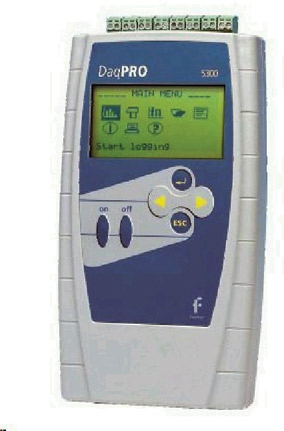
Figure i. 8-channel data logger for universal inputs (includes thermocouples). www.iseincstore.com
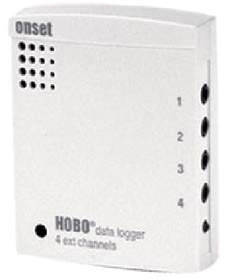
Figure 2. 4-channel data logger for thermistors, RTDs, voltage and current sources.
Wet-bulb Temperature Measurement
Wet-bulb temperature tin can be measured by placing a moisture cotton sock or tube (available, for example, from Pepperell Braiding Co., Pepperell, Mass.) over the active portion (eastward.chiliad. bulb or tip) of the temperature sensor (encounter figure 3). The sock must be kept continuously moist and make clean for accurate readings. Placement of sensors should be adjacent to the product at locations in the dehydrator where temperature variation is the greatest (due east.k. corners or edges or areas where air period and heat treatment may exist blocked or express).
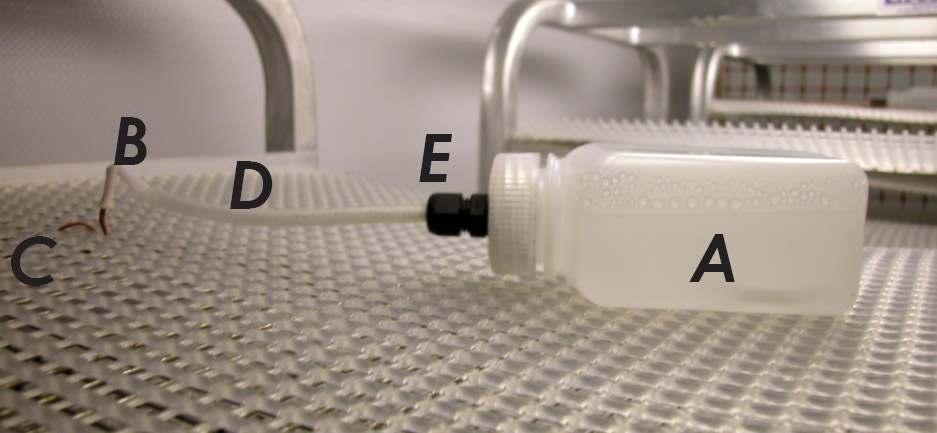
Figure three. Setup for wet-bulb temperature sensing with a water reservoir "A" (plastic container) and 36-inch long by 1/4-inch diameter cotton sock "B" placed over the tip of the thermocouple "C." A clear ten cm long Tygon ® tube "D" covers the cotton wool wick from the reservoir to inside almost 2 cm of the terminus of the wick to maintain cleanliness. When the exposed portion of the cotton wool wick becomes soiled, fresh cloth is exposed past pulling the wick out of the reservoir and cut off the soiled portion. A Nylon liquid-tight string grip "E" (69915K47, McMaster Carr, Atlanta, GA) was threaded into the hat of the container and used to agree the Tygon® tubing in place.
Fans, Fan Placement and Air Flow
Good air circulation will reduce temperature variation in the dehydrator (Bowser and Weckler, 2008). Airflow should be uniformly directed over the heating source, across the production and returned back to the fan for recirculation. Some air should be wearied during the drying process to remove moisture. Return air to the fan is always directed to the suction (or low pressure) side of the blades. Fan speed, or air flow volume, can be set to provide enough air velocity to maintain the desired temperature in the dehydration sleeping room and consume a minimum of energy; encounter Bowser and Weckler (2008) for details.
Temperature Setting
Dehydrator temperature setting is an of import factor for effective pathogen reduction. To determine the temperature set point, two pieces of data are needed: a numerical value that represents the natural variation of temperature in the dehydrator (called the standard difference) and the total temperature variation that can be tolerated in the hasty dehydrator.
Standard Deviation
Standard deviation is a measurement of variation of a data gear up (temperature data) collected at unlike locations in the aridity chamber. To make up one's mind the standard divergence of a data set for the dehydrator, collect at least 12 temperature data points at different locations in the dehydrator and perform the following calculation:
Where x is an individual temperature data signal, x is the average value of all of the data points, and n is the full number of data points collected. More data (temperatures at different points in your dehydrator) will result in a more authentic number for the standard deviation. The value "s" is the standard difference of the data set and tin be used as an estimate of the standard divergence "σ" of the population of all possible information, and 10 can be used to guess μ, the boilerplate of the population of all data.
Acceptable Variation
What is an acceptable variation for the application? The distribution of temperatures measured in most dehydrator systems will approximate a bell bend (known equally a "normal" distribution) shown in effigy 4. The distance from the mean, μ, to the point of inflection of the bend is one standard difference (σ, or sigma).
If the lethality process temperature fix point (wet-seedling temperature in the dehydrator) is equal to μ, and then in that location is a chance that one-half of the product will not meet the lethality requirement (the amount of production under the bell curve to the left of μ). To reduce chances that product does non run across lethality requirements, μ tin can exist increased by a given corporeality or the processing time (for lethality) can be increased according to Table i. Increasing μ and/or the processing fourth dimension may crusade issues related to product quality, consistency and economic system.
The lethality process set betoken temperature, μ, or the processing time should exist increased plenty to reduce the run a risk of producing under processed product to an acceptable level. Modernistic statistical command schemes often decide equipment settings by calculation a multiple of sigma to μ. Table ii (Joglekar, 2003) shows several levels of sigma and their effect on the process. For example if the lethality process temperature is set up at μ + iii σ, the result would exist 33,400 possible defects (under-candy production) per million pieces of product. If the temperature setting is μ + 6 σ, the number of defects per million pieces is statistically less than ii. Many companies are working to achieve a six-sigma goal for their processes.
Tabular array ii. Wet-seedling temperature setting for a dehydrator (μ + sigma level) and the expected number of products not reaching target temperatures (assumes a normal distribution with a 1.5 σ shift in the mean).
| Sigma Level | % Lethality | Number of units not reaching lethality temperature per 1,000,000 units processed |
|---|---|---|
| iii σ | 96.66 | 33,400.0 |
| 4 σ | 99.699 | iii.105.0 |
| 5 σ | 99.9884 | 116.5 |
| 5.5 σ | 99.9969 | 31.5 |
| 6 σ | 99.99983 | 1.7 |
Example 1:
If the boilerplate wet-bulb temperature in a dehydrator is μ = 140.0 F with σ = 0.83 F, and the processor wishes to achieve a six-sigma level of product lethality, so the temperature set indicate of the dehydrator should exist adapted to μ + 6 σ or 140.0 F + six ten (0.83) = 145.0 F with the process time remaining at 12 minutes (for a 140.0 F process).
Case 2:
The boilerplate moisture-seedling temperature in a dehydrator is μ = 140.0 F with σ = 0.83 F, and the processor wishes to achieve a six-sigma level of production lethality past increasing the processing time. The processing time should be prepare according to the lowest lethality temperature (μ – 6 σ) reached in the dehydrator. The lowest temperature is calculated equally 140.0 F – 6 x (0.83) = 135.0 F. The process fourth dimension should be gear up to 37 minutes according to Table 1.
Food Safety
Hasty is considered a safe food, but studies have shown that pathogens tin survive the moderate drying conditions of some jerky processes (Allen et al., 2007). A process that meets six-sigma requirements (equally described in tabular array 2) for lethality is statistically capable of producing fewer than 2 defects (under-processed products) per meg units (Joglekar, 2003). Jerky processors can amend food quality and safety by understanding and minimizing temperature variation in their dehydrator and establishing a lethality process that minimizes the likelihood of under-processed products.
Conclusion
Dehydrated meat products are a popular snack particular in today'due south food market. The proper understanding, measurement, and control of heat and wet are crucial to manufacturing a production that meets regulatory requirements, satisfies consumer demands and, most chiefly, is profitable.
References
Allen, One thousand.D., D. Cornforth, D. Whittier, M. Vasavada, and B. Nummer. 2007. Evaluation of high humidity and wet marinade methods for pasteurization of hasty. Journal of Food Scientific discipline; (72)vii: 351-355.
Joglekar, A.M. 2003. Statistical methods for six sigma in R&D and manufacturing. John Wiley and Sons. New Jersey.
Bowser, T.J. and P.R. Weckler. 2008. Validation guidelines for a jerky pasteurization process in a low-toll dehydrator. Bentham Science Publications, world wide web.bentham.org/open/index.htm, The Open Food Science Journal (2) 43-48.
Bowser, T.J. 2007. Construction and performance manual for: Low-cost, safe dehydrator for pocket-size and very small meat processors. Oklahoma State University, Robert M. Kerr Food & Agricultural Products Eye. Cyberspace: http://fapc.biz/files/DehydratorManualV1.pdf (accessed May 23, 2008).
Buege, D.R., Searls, G., Ingham, S.C. 2005. Lethality of commercial whole-muscle beefiness jerky manufacturing process against Salmonella serovars and Escherichia coli O157:H7. J Nutrient Protection; 69(9): 2091-99.
USDA FSIS. 2007. Compliance guideline for meat and poultry hasty produced past small and very pocket-sized plants. Internet: http://world wide web.fsis.usda.gov/PDF/Compliance_Guideline_Jerky.pdf. (accessed May 23, 2008).
USDA FSIS. 1999. Appendix A of the "Compliance Guidelines for Coming together Lethality Operation Standards for Certain Meat and Poultry Products". Internet: http://www.fsis.usda.gov/oa/fr/95033F-a.htm; updated June, (accessed May 23, 2008).
Timothy J. Bowser
FAPC Nutrient Process Engineer
Jacob Nelson
FAPC Value-Added Meat Processing Specialist
Was this data helpful?
YESNO
ashworthprios1985.blogspot.com
Source: https://extension.okstate.edu/fact-sheets/consistent-lethality-treatment-for-small-scale-jerky-dehydrators.html
0 Response to "Beef Jerky Lethality Step Temperature Chart"
Postar um comentário