India Is the Largest Beef Exporter
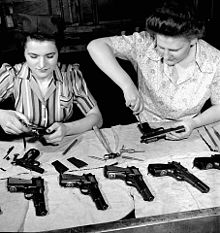
The arms industry, also known as the arms trade, is a global industry which manufactures and sells weapons and military engineering. It consists of a commercial manufacture involved in the research and development, engineering, production, and servicing of military textile, equipment, and facilities. Arms-producing companies, besides referred to as artillery dealers, or as the military industry, produce arms for the armed forces of states and for civilians. Departments of government also operate in the arms manufacture, buying and selling weapons, munitions and other military items. An arsenal is a place where arms and ammunition - whether privately or publicly owned - are made, maintained and repaired, stored, or issued, in any combination. Products of the arms industry include guns, artillery, ammunition, missiles, military aircraft, war machine vehicles, ships, electronic systems, night-vision devices, holographic weapon sights, laser rangefinders, light amplification by stimulated emission of radiation sights, hand grenades, landmines and more. The arms industry too provides other logistical and operational support.
The Stockholm International Peace Research Institute (SIPRI) estimated military expenditures as of 2018[update] at $1822 billion.[i] This represented a relative turn down from 1990, when military expenditures made up 4% of globe Gross domestic product. Office of the money goes to the procurement of armed forces hardware and services from the armed forces industry. The combined arms-sales of the superlative 100 largest arms-producing companies and military services companies (excluding Prc) totaled $420 billion in 2018, according to SIPRI.[2] This was 4.half-dozen percent higher than sales in 2017 and marks the fourth sequent year of growth in Top 100 arms sales. In 2004 over $30 billion were spent in the international artillery-trade (a figure that excludes domestic sales of arms).[3] Co-ordinate to the institute, the volume of international transfers of major weapons in 2014–18 was vii.eight percent higher than in 2009–xiii and 23 percentage higher than in 2004–2008. The five largest exporters in 2014–18 were the The states, Russian federation, France, Federal republic of germany and China whilst the v biggest importers were Saudi arabia, India, Egypt, Commonwealth of australia and Algeria.[4]
Many industrialized countries have a domestic arms-industry to supply their own armed services forces. Some countries too have a substantial legal or illegal domestic trade in weapons for utilise by their own citizens, primarily for cocky-defence force, hunting or sporting purposes. Illegal trade in small-scale arms occurs in many countries and regions afflicted by political instability. The Pocket-size Arms Survey estimates that 875 one thousand thousand small artillery circulate worldwide, produced by more than 1,000 companies from most 100 countries.[5]
Governments honor contracts to supply their state'due south military; such artillery contracts tin get of substantial political importance. The link between politics and the artillery trade can consequence in the development of what U.S. President Dwight D. Eisenhower described in 1961 as a military–industrial circuitous, where the armed forces, commerce, and politics become closely linked, similarly to the European multilateral defence force procurement. Diverse corporations, some publicly held, others individual, bid for these contracts, which are ofttimes worth many billions of dollars. Sometimes, as with the contract for the international Joint Strike Fighter, a competitive tendering process takes place, with the decision made on the merits of the designs submitted past the companies involved. Other times, no bidding or competition takes place.
History [edit]
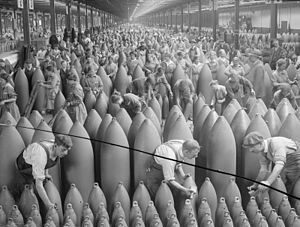
Painting shells in a beat filling manufacturing plant during Globe War I.
During the early modern menstruum, England, France, the netherlands and some states in Germany became cocky-sufficient in arms production, with improvidence and migration of skilled workers to more peripheral countries such as Portugal and Russian federation.
The modern arms industry emerged in the second one-half of the nineteenth century as a product of the cosmos and expansion of the first large military–industrial companies. Every bit smaller countries (and fifty-fifty newly industrializing countries similar Russia and Japan) could no longer produce cut-edge military equipment with their indigenous resources and capacity, they increasingly began to contract the manufacture of military equipment, such as battleships, artillery pieces and rifles to foreign firms.
In 1854, the British government awarded a contract to the Elswick Ordnance Company for the supply of his latest breech loading rifled artillery pieces. This galvanized the private sector into weapons product, with the surplus existence increasingly exported to strange countries. Armstrong became one of the starting time international arms dealers, selling his weapon systems to governments across the globe from Brazil to Nihon.[6] In 1884, he opened a shipyard at Elswick to specialize in warship production—at the time, it was the only factory in the world that could build a battleship and arm it completely.[7] The factory produced warships for many navies, including the Imperial Japanese Navy. Several Armstrong cruisers played an important role in defeating the Russian fleet at the Battle of Tsushima in 1905.
In the American Ceremonious War in 1861 the North had a modest just cognizable reward over the South due to its ability to produce (in relatively small numbers) breech-loading rifles for utilize against the muzzle-loading rifled muskets the were largely the sole variety of shoulder arm utilized by the South. This began the transition to industrially produced mechanized weapons such equally the Gatling gun.[eight]
This industrial innovation in the defence force industry was adopted past Prussia in 1866 and 1870–71 in its defeat of Austria and France respectively. Past this time the auto gun had begun inbound into the militaries. The first example of its effectiveness was in 1899 during the Boer War and in 1905 during the Russo-Japanese War. However, Germany were leaders in innovation of weapons and used this innovation most defeating the allies in Earth War I.
In 1885, France decided to capitalize on this increasingly lucrative form of trade and repealed its ban on weapon exports. The regulatory framework for the period up to the First World War was characterized by a laissez-faire policy that placed petty obstruction in the way of weapons exports. Due to the carnage of Globe War I, arms traders began to be regarded with odium as "merchants of death" and were defendant of having instigated and perpetuated the war in order to maximize their profits from arms sales. An inquiry into these allegations in Britain failed to find evidence to support them. All the same, the sea alter in attitude about war more than generally meant that governments began to control and regulate the merchandise themselves.
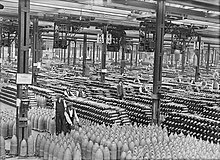
Stacks of shells in the shell filling factory during World War I.
The volume of the arms trade profoundly increased during the 20th century, and information technology began to be used as a political tool, especially during the Cold War where the United States and the USSR supplied weapons to their proxies beyond the world, particularly 3rd globe countries (see Nixon Doctrine).[9]
Sectors [edit]

The AK series of weapons have been produced in greater numbers than any other firearm and have been used in conflicts all over the world.
Land-based weapon [edit]
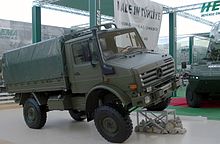
This category includes everything from low-cal artillery to heavy arms, and the bulk of producers are small. Many are located in third globe countries. International trade in handguns, auto guns, tanks, armored personnel carriers, and other relatively inexpensive weapons is substantial. There is relatively little regulation at the international level, and as a result, many weapons fall into the easily of organized crime, rebel forces, terrorists, or regimes nether sanctions.[10]
Small artillery [edit]
The Control Arms Entrada, founded past Amnesty International, Oxfam, and the International Action Network on Small Arms, estimated in 2003 that there are over 639 million small arms in circulation, and that over 1,135 companies based in more than than 98 countries manufacture small arms too as their various components and ammunition.[xi]
Aerospace systems [edit]

Encompassing armed forces aircraft (both state-based and naval aviation), conventional missiles, and military satellites, this is the most technologically advanced sector of the market. It is also the to the lowest degree competitive from an economic standpoint, with a scattering of companies dominating the entire market. The top clients and major producers are virtually all located in the western world and Russia, with the Usa easily in the first place. Prominent aerospace firms include Rolls Royce, Hindustan Aeronautics Express, BAE Systems, Saab AB, Dassault Aviation, Sukhoi, Mikoyan, EADS, Leonardo, Thales Grouping, Lockheed Martin, Northrop Grumman, Raytheon Technologies, and Boeing. At that place are also several multinational consortia by and large involved in the manufacturing of fighter jets, such every bit the Eurofighter. The largest military contract in history, signed in October 2001, involved the evolution of the Joint Strike Fighter.[10]
[edit]
Some of the earth'southward dandy powers maintain substantial naval forces to provide a global presence, with the largest nations possessing shipping carriers, nuclear submarines and avant-garde anti-air defense systems. The vast majority of military ships are conventionally powered, but some are nuclear-powered. There is besides a large global market in second-hand naval vessels, generally purchased past developing countries from Western governments.[ten]
Cybersecurity industry [edit]
The cybersecurity manufacture is becoming the most of import defense industry as cyber attacks are being deemed equally one of the greatest risks to defense force in the adjacent 10 years equally cited past the NATO review in 2013.[12] Therefore, high levels of investment has been placed in the cybersecurity industry to produce new software to protect the ever-growing transition to digitally run hardware. For the military manufacture, it is vital that protections are used for systems used for reconnaissance, surveillance, and intelligence gathering.
Nonetheless, cyber attacks and cyber attackers have get more advanced in their field using techniques such as Dynamic Trojan Equus caballus Network (DTHN) Internet Worm, Zero-Day Assault, and Stealth Bot. As a issue, the cybersecurity industry has had to amend the defence technologies to remove any vulnerability to cyber attacks using systems such as the Security of Information (SIM), Next-Generation Firewalls (NGFWs), and DDoS techniques.
Every bit the threat to computers grows, the demand for cyber protection will rise, resulting in the growth of the cybersecurity manufacture. Information technology is expected that the industry volition be dominated by the defence and homeland security agencies that will make up xl% of the industry.[xiii]
International arms transfers [edit]
According to research institute SIPRI, the volume of international transfers of major weapons in 2010–14 was 16 percent college than in 2005–2009. The 5 biggest exporters in 2010–2014 were the U.s.a., Russia, China, Germany and France, and the five biggest importers were India, Saudi arabia, China, the United Arab Emirates and Pakistan. The flow of artillery to the Middle East increased by 87 percent between 2009–xiii and 2014–eighteen, while there was a subtract in flows to all other regions: Africa, the Americas, Asia and Oceania, and Europe.[14]
SIPRI has identified 67 countries as exporters of major weapons in 2014–18. The top five exporters during the period were responsible for 75 percent of all arms exports. The composition of the five largest exporters of arms inverse betwixt 2014–xviii remained unchanged compared to 2009–thirteen, although their combined total exports of major artillery were ten percent higher. In 2014–eighteen there tin exist seen significant increases in arms exports from the Usa, France and Germany, while Chinese exports rose marginally and Russian exports decreased.[14]
In 2014–18, 155 countries (about iii-quarters of all countries) imported major weapons. The acme v recipients accounted for 33 percent of the total arms imports during the catamenia. The top five arms importers - Saudi Arabia, Bharat, Egypt, Australia and Algeria - accounted for 35 percent of full arms imports in 2014–18. Of these, Saudi arabia and India were among the top v importers in both 2009–13 and 2014–xviii.
In 2014–18, the book of major arms international transfers was vii.8 per centum higher than in 2009-13 and 23 per centum than that in 2004–08. The largest artillery importer was Saudi Arabia, importing arms primarily from the The states, United Kingdom and France. Between 2009–13 and 2014–18, the catamenia of arms to the Centre East increased by 87 percent. Also including Bharat, Arab republic of egypt, Australia and Algeria, the top five importers received 35 percentage of the total arms imports, during 2014–18. Besides, the largest exporters were the United States, Russia, French republic, Deutschland and Mainland china.[14]
The 2022 Russian invasion of Ukraine changed the National Shooting Sports Foundation members ability to obtain an export license from taking a calendar month to taking merely 4 days.[fifteen] This was due to the Us Department of Commerce and agencies associated with ITAR expediting weapons shipments to Ukraine.[16] In addition, the time information technology took to obtain a permit to buy a firearm in Ukraine also decreased from a few months to a few days.[17]
World's largest artillery exporters [edit]
Figures are SIPRI Trend Indicator Values (TIVs) expressed in millions. These numbers may non represent real financial flows equally prices for the underlying arms tin be as depression as zero in the case of military assistance. The following are estimates from Stockholm International Peace Research Institute.[18]
| 2020 Rank | Supplier | Artillery Exp (in billion TIV) |
|---|---|---|
| one |  Usa Usa | ix,372 |
| two |  Russia Russia | three,203 |
| 3 |  French republic French republic | 1,995 |
| 4 |  Federal republic of germany Federal republic of germany | 1,232 |
| 5 |  Spain Spain | 1,201 |
| 6 |  South korea South korea | 827 |
| 7 |  Italy Italy | 806 |
| 8 |  Cathay Cathay | 760 |
| 9 |  Netherlands Netherlands | 488 |
| 10 |  United Kingdom United Kingdom | 429 |
| eleven |  Australia Australia | 396 |

Sgraffito at the Lambert Sevart weapons manufacturing plant, in Liege (Kingdom of belgium) (early 20th century).
Overall global arms exports rose of about 6 per-cent in the terminal 5 years compared to the period 2010-2014 and increased by twenty per-cent since 2005–2009.[19]
Annotation that rankings for exporters beneath a billion dollars are less meaningful, equally they can exist swayed by single contracts. A much more authentic moving picture of export volume, costless from yearly fluctuations, is presented by five-twelvemonth moving averages.
Next to SIPRI, there are several other sources that provide data on international transfers of arms. These include national reports by national governments about artillery exports, the United nations annals on conventional arms, and an annual publication by the U.Southward. Congressional Research Service that includes data on arms exports to developing countries as compiled past U.S. intelligence agencies. Due to the different methodologies and definitions used dissimilar sources often provide significantly different data.
World's largest postwar arms exporter [edit]

Share of arms sales by country in 2013. Source is provided by SIPRI.[20]
SIPRI uses the "trend-indicator values" (TIV). These are based on the known unit production costs of weapons and stand for the transfer of military resources rather than the financial value of the transfer.[21] [22]
| 1950–2019 Rank | Supplier | Arms Exp (in billion TIV) |
|---|---|---|
| 1 | United States | 692,123 |
| 2 | Russia | 598,375 |
| 3 | United Kingdom | 143,205 |
| 4 | France | 125,932 |
| 5 | Germany | 87,431 |
| 6 | Communist china | 56,160 |
| 7 | Italy | 33,296 |
| 8 |  Czechia Czechia | 31,291 |
| 9 | Netherlands | 24,543 |
| 10 |  State of israel State of israel | 17,643 |
| 10 |  Iran Iran | 11,243 |
World'south largest arms importers [edit]
Units are in Trend Indicator Values expressed as millions of U.S. dollars at 1990s prices. These numbers may non represent real financial flows as prices for the underlying artillery can exist as low as cypher in the case of war machine help.[21]
| 2020 Rank | Recipient | Arms Imp (in billion TIV) |
|---|---|---|
| one |  India India | 2,799 |
| 2 |  Kingdom of saudi arabia Kingdom of saudi arabia | two,466 |
| 3 | Australia | 1,658 |
| iv | South Korea | i,317 |
| five |  Arab republic of egypt Arab republic of egypt | 1,311 |
| 6 | China | 811 |
| 7 |  Qatar Qatar | 783 |
| 8 | Great britain | 764 |
| 9 |  Islamic republic of pakistan Islamic republic of pakistan | 759 |
| 10 |  Japan Japan | 724 |
Artillery import rankings fluctuate heavily every bit countries enter and exit wars. Export data tend to exist less volatile equally exporters tend to be more technologically advanced and have stable production flows. 5-yr moving averages present a much more than accurate picture of import book, gratis from yearly fluctuations.
List of major weapon manufacturers [edit]
This is a list of the globe'due south largest arms manufacturers and other military service companies who profit the most from the War economy, their origin is shown as well. The information is based on a list published by the Stockholm International Peace Research Institute for 2020.[23] The list provided past the SIPRI The numbers are in billions of United states of america dollars.
| Rank | Company name | Defense Revenue (US$ billions) | % of Total Acquirement from Defense |
|---|---|---|---|
| 1 | Lockheed Martin | 53.two | 89% |
| 2 | Boeing | 33.v | 44% |
| iii | Northrop Grumman | 29.2 | 86% |
| 4 | Raytheon Technologies | 25.3 | 87% |
| 5 | General Dynamics | 24.v | 62% |
| 6 | Aviation Industry Corporation of China | 22.4 | 34% |
| vii | BAE Systems | 22.2 | 95% |
| 8 | China Electronics Technology Group | 15.0 | 46% |
| 9 | Norinco | fourteen.five | 22% |
| x | L3Harris Technologies | xiii.ix | 77% |
| 11 | United Technologies (since April 2020 Raytheon Technologies) | 13.1 | 17% |
| 12 | Leonardo Due south.p.A. | 11.one | 72% |
| 13 |  Airbus Airbus | 11.0 | 14% |
| 14 | Thales Group | ix.4 | 46% |
| fifteen | Almaz-Antey | ix.iv | 98% |
Arms command [edit]
Artillery control refers to international restrictions upon the development, production, stockpiling, proliferation and usage of pocket-sized arms, conventional weapons, and weapons of mass destruction.[24] It is typically exercised through the use of diplomacy, which seeks to persuade governments to accept such limitations through agreements and treaties, although it may also exist forced upon not-consenting governments.
Notable international arms command treaties [edit]

Global weapons sales from 1950–2006
- Geneva Protocol on chemical and biological weapons, 1925
- Outer Infinite Treaty, signed and entered into force 1967
- Biological Weapons Convention, signed 1972, entered into force 1975
- Missile Applied science Control Regime (MTCR), 1987
- Chemical Weapons Convention, signed 1993, entered into force 1997
- Ottawa Treaty on anti-personnel state mines, signed 1997, entered into strength 1999
- New START Treaty, signed by Russian federation and the Usa in April 2010, entered into forcefulness in February 2011
- Arms Merchandise Treaty, concluded in 2013, entered into strength on 24 December 2014.[25]
See also [edit]
- Artillery race
- Arms control
- Arms deal (disambiguation)
- Arms embargo
- Artillery trafficking
- Campaign Against Arms Trade
- Cyber-artillery industry
- Disarmament
- Guns versus butter model
- History of war machine technology
- List of chemical arms control agreements
- List of U.s.a. defense contractors
- List of nigh-produced firearms
- Military Keynesianism
- Naval conference (disambiguation)
- Nuclear disarmament
- Offset agreement
- Peace and conflict studies
- Peace dividend
- Permanent war economic system
- Private armed services visitor
- Minor Arms and Lite Weapons (SALW)
- Small arms trade
- Torture trade
- United Nations Part for Disarmament Affairs
References [edit]
- ^ Wezeman, Siemon T. (Apr 2019). "Trends in Earth Military Expenditure, 2018". SIPRI . Retrieved Dec 18, 2019.
- ^ Fleurant, Aude; Kuimova, Alexandra; Silva, Diego Lopes da; Tian, Nan; Wezeman, Pieter D.; Wezeman, Siemon T. (December 9, 2019). "The SIPRI Top 100 Arms-producing and Military Services Companies, 2018". SIPRI . Retrieved December eighteen, 2019.
- ^ "Arms trade key statistics". BBC NEWS. September 15, 2005. Retrieved May 9, 2012.
- ^ Wezeman, Pieter D.; Fleurant, Aude; Kuimova, Alexandra; Tian, Nan; Wezeman, Siemon T. (March xi, 2019). "Trends in International Artillery Transfers, 2018". SIPRI . Retrieved December 18, 2019.
- ^ "Modest Arms Survey — Weapons and Markets- 875m small arms worldwide, value of authorized trade is more than $8.5b". December 8, 2014. Archived from the original on November 2, 2010. Retrieved March 26, 2015.
- ^ "William Armstrong | About the Human being". williamarmstrong.info.
- ^ Dougan, David (1970). The Bully Gun-Maker: The Story of Lord Armstrong. Sandhill Press Ltd. ISBN0-946098-23-9.
- ^ "Defense force Industries - Military machine History - Oxford Bibliographies - obo". www.oxfordbibliographies.com . Retrieved November 3, 2015.
- ^ Stohl, Rachel; Grillot, Suzette (2013). The International Artillery Trade. Wiley Press. ISBN9780745654188 . Retrieved Feb 7, 2013.
- ^ a b c "International Defence Industry". Archived from the original on July 26, 2011. Retrieved May 20, 2007. . www.fpa.org
- ^ Debbie Hillier; Brian Wood (2003). "Shattered Lives – the case for tough international arms control" (PDF). Command Arms Entrada. p. xix. Archived from the original (PDF) on July 23, 2011. Retrieved March 28, 2009.
- ^ "NATO review | The defence force industry - a irresolute game?". www.nato.int . Retrieved July 25, 2021.
- ^ "Cyber security for the defence force industry | Cyber Security Review". www.cybersecurity-review.com. May 5, 2015. Retrieved November ii, 2015.
- ^ a b c Fleurant, Aude; Wezeman, Pieter D.; Wezeman, Siemon T.; Tian, Nan; Kuimova, Alexandra (March 2019). "TRENDS IN INTERNATIONAL Artillery TRANSFERS, 2018" (PDF). sipri.org . Retrieved July 25, 2021.
- ^ "American gunmakers ramp upward efforts to help Ukrainians fight back confronting Putin – Fortune".
- ^ "U.Southward. Gunmakers' efforts to get weapons to Ukraine often stifled past red tape". Newsweek. March 18, 2022.
- ^ Marshall, Andrew R. c. (March 2022). "Ukrainians rush to purchase rifles, shotguns equally constabulary relax rules". Reuters.
- ^ "Stockholm International Peace Research Institute". armstrade.sipri.org . Retrieved July 25, 2021.
- ^ "The 5 major arms exporters in the world". International Insider. March 13, 2020. Retrieved March thirteen, 2020.
- ^ Wezeman, Pieter D. (December 7, 2020). "Arms product". SIPRI . Retrieved July 25, 2021.
- ^ a b "SIPRI Artillery Transfers Database | SIPRI". www.sipri.org.
- ^ Live, Nigeria News. "World'southward Top 5 Weapon Exporters -Nigeria News Live". www.newsliveng.com. Archived from the original on Dec xix, 2019. Retrieved October 4, 2019.
- ^ "Mapping the International presence of the Earth's Largest Arms Companies" (PDF). Stockholm International Peace Research Constitute. December 2020. Retrieved July 25, 2021.
- ^ Barry Kolodkin. "What Is Arms Command?" (Article). Almost.com, United states Foreign Policy. The New York Times Company. Retrieved May 13, 2012.
- ^ Delgado, Andrea (Feb 23, 2015). "Explainer: what is the Arms Trade Treaty?". The Conversation . Retrieved July 25, 2021.
ashworthprios1985.blogspot.com
Source: https://en.wikipedia.org/wiki/Arms_industry
0 Response to "India Is the Largest Beef Exporter"
Postar um comentário